Processed Honours Final Presentation Video
I’ve cleaned up and merged the videos of my final research presentation that I recently uncovered The cleaned up version has been put on my ZFS Research Page.
Alternatively you can watch it on YouTube:
I’ve cleaned up and merged the videos of my final research presentation that I recently uncovered The cleaned up version has been put on my ZFS Research Page.
Alternatively you can watch it on YouTube:
While looking through some old USBs I’ve discovered a recording of the final presentation of my Honours Research in late 2014. I had believed this was completely lost, like the video of my BSDCan presentation which was not successfully recorded due to technical issues.
The video files have been put on my ZFS research page. The orignals are shot in profile on a 2013 era smartphone and the volume is very low - I might to try and clean them up a bit, but very glad to have the files regardless.
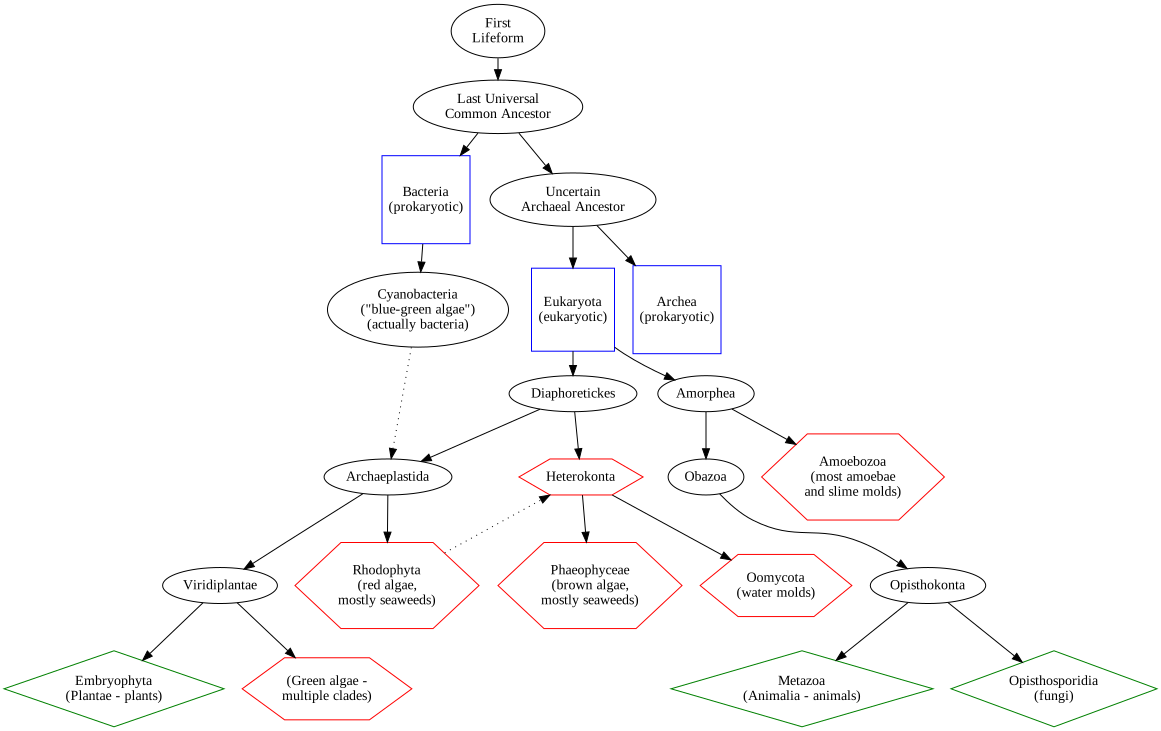
In the first part of this series, I discussed taxonomic terminology such as clades and kingdoms, but didn’t go into the actual groups and the lifeforms within them. This article will provide a top-down phylogenetic overview of all lifeforms on Earth, as well as a discussion of how endosymbiosis has provided an alternate path for genetic material and evolution.
The third edition of my monthly pile of science links.
Leap day edition of my monthly science links (aka monthly cleaning out my bookmarks).
An article in last month’s Science, “Cooked starchy rhizomes in Africa 170 thousand years ago”, provides some archaeological evidence of early humans cooking and eating tuber-like vegetables.
In the interest of filling more blog pages and clearing out lots of bookmarks (“that’s interesting, I should post that”), here are some assorted science links I’ve come across recently, with minimal annotation.
This is a mental math technique to solve non-trivial integer multiplication I picked up from one of Arthur Benjamin’s talks, and is widely used by other “mathemagicians” to solve large products.
It converts an n × n multiplication problem into a n² set of single digit multiplications, arithmetically identical to the “Lattice Method”. However, instead of filling the lattice first and then summing each diagonal, this method calculates each sum as soon as possible - thus you only need to keep track of the bare minimum of working data and it becomes possible to do the problem entirely in your head.
In a similar vein to last week’s post on simplifying squares, this one uses some basic algebra to make it easier to multiply numbers between 10-20:
(10 + x)(10 + y) = 100 + 10x + 10y + xy = 10(x + y + 10) + xy
Part one of what I hope will be series of at least two articles on how different lifeforms differ.
To start off, this article will give an overview of the hierarchical classification of biological life, with a focus on the nomenclature of biological nomenclature.